
The Department of Justice extended compliance deadlines for ADA Title II by one year. As schools and districts work to use that time wisely, Edlio can help them meet ADA compliance now, and ensure their websites and digital content maintain accessibility in the future as well.
Last week, the first major deadline for ADA Title II compliance was set to arrive, when the Department of Justice issued an extension to the deadlines in the form of an Interim Final Rule (IFR), pushing compliance deadlines out one year. A primary reason for the extension was the feedback received from schools and districts about the time and resources needed to comply with the requirements. The IFR states “The Department finds the compliance concerns raised in the foregoing correspondence to be compelling and upon its own review determines that it overestimated the capabilities (whether staffing or technology) of covered entities to comply with the rule in the time frames provided.”
For many schools and district leaders, this extension brings a sigh of relief, as they were feeling unprepared as the first deadline loomed. The National School Public Relations Association (NSPRA) recently surveyed its members about the state of their digital accessibility. Only 14% of respondents said their districts had “completed or nearly completed” the updates needed to meet the new requirements. We’ve talked with educators and administrators across the country at events over the past several months as well, and those conversations are consistent with the NSPRA survey results. There is a sense of overwhelm for many schools and districts, as they work to address their current state of their digital accessibility.
This compliance deadline extension presents an opportunity and an obligation to use that time to make significant progress. Edlio is here to help schools and districts navigate the challenge of the moment, as well as improve digital accessibility in the long term.
ADA Title II Overview
What Does Title II of the Americans with Disabilities Act (ADA) require?
Title II (Subpart H) of the Americans with Disabilities Act applies to digital content and digital services provided by state and local governments, which include all public schools. Title II requires that all public schools and districts make web content and mobile apps accessible and usable by individuals with disabilities. This includes text, images, sounds, videos, controls, animations, and conventional electronic documents (word processing, presentation, PDF, and spreadsheet files).
What is the standard web content and mobile apps need to meet under the rule?
The Web Content Accessibility Guidelines (WCAG) Version 2.1, Level AA is the technical standard for state and local governments’ web content and mobile apps. The WCAG standards have three levels of conformance: A (lowest), AA, and AAA (highest). They have also been updated over the years, and are currently at version 2.2. However, the ADA Title II compliance requirement is WCAG Version 2.1, Level AA.
Are there any exceptions to this rule?
There are limited exceptions, including some archived web content, preexisting electronic documents and social media posts, individualized documents, and third-party content. The Department of Justice provides a summary of exceptions and their applicability in their Title II Fact Sheet.
When do schools and districts need to comply?
The compliance deadline for schools and districts depends on the population of the community they serve, not the enrollment of the district:
- For districts serving more than 50,000 people, the compliance deadline is April 26, 2027.
- For districts serving less than 50,000 people, the compliance deadline is April 26, 2028.
Existing ADA Title II Resources
There are some great resources available to help schools and districts understand the ADA Title II requirements and WCAG standards, including:
- An ADA Title II Fact Sheet, which provides a summary of the rule, requirements, exceptions and more
- A Quick Reference Guide by the World Wide Web Consortium (W3C) that allows users to filter WCAG standards by version (2.1, 2.2) and level (A, AA, AAA)
- The ADA Information Line, where accessibility specialists are available to answer questions
- The Interim Final Rule (IFR) from the Department of Justice that speaks to the extension of compliance dates for the requirements for web content and mobile app accessibility
How Edlio Can Help
Edlio's platform is designed and built to WCAG 2.2 Level AA standards, exceeding the 2.1 standards called for in ADA Title II. All website templates, CMS components, and public-facing interfaces are engineered for accessibility from the ground up:
- Skip-to-content links for screen reader and keyboard navigation
- Sufficient color contrast ratios (minimum 4.5:1 for all text)
- Keyboard-navigable site structure and menus throughout
- Properly structured heading hierarchy for screen readers
- ADA-compliant form builder with required labels and error handling built in
- Automatic closed captioning for all uploaded videos
Edlio Accessibility is an AI-powered tool built into our CMS that scans your website and automatically fixes common accessibility errors.
The scanning function reviews all published pages, as well as news and page drafts, allowing you to review and address any issues prior to publication. There’s also an “Accessibility” tab in the menu that will allow you to sort identified issues from across your site and prioritize which issues to tackle first.
The remediation function allows you to fix accessibility issues with the click of a button, including:
- Generating alt text for images
- Fixing color contrast issues
- Improving link descriptions
- Adjusting heading structures
- Reviewing content for readability
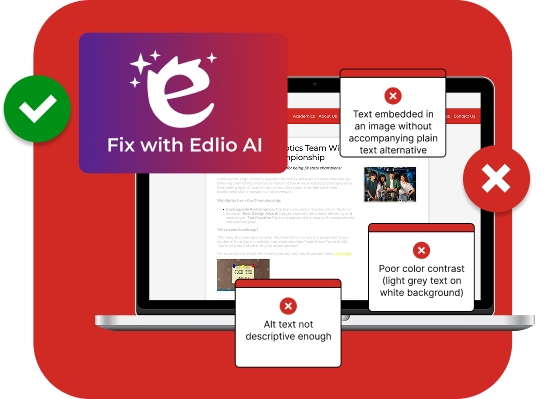
Every time you use Edlio Accessibility, it helps you learn what to look out for—so you can keep your site compliant without the stress.
Improving Digital Accessibility Beyond Compliance Deadlines
While the 2027 and 2028 deadlines are dominating the conversation right now, digital accessibility is an ongoing process where compliance is just one step. It’s a journey of progress versus perfection. The larger goal is to create a culture of accessibility, and ensure that schools and districts have the tools to maintain accessibility as their websites and digital content evolve. With a more accessible digital presence, more families and community members can be part of the conversation. Edlio is here to help schools and districts support their entire education ecosystem, equipping them to reach every family, connect their community, and uplift every student.

